business Jun 8, 2026
Business Storytelling Framework - The Ultimate Guide for Brands

Most brands struggle to communicate clearly, because they lack a solid business storytelling framework. A business storytelling framework is a simple way to turn complex ideas, data, and messages into stories that people understand, remember, and act on. Without it, marketing often feels scattered, overly technical, or just plain forgettable. That is the real problem many businesses face today. They have great products and strong value, but their message does not connect. Audiences lose interest, presentations fall flat, and content fails to convert. This is where the right approach makes all the difference. When you combine storytelling with strong visual communication, your message becomes clear, engaging, and persuasive. That is exactly what Brief Cab helps you do. They turn your ideas into powerful visual stories that capture attention and drive results. If you want your message to stand out and truly connect, it is time to rethink how you tell your story. Work with Brief Cab or explore their work to see the difference.
What Is a Business Storytelling Framework?
A business storytelling framework is a simple structure that helps you turn ideas, customer problems, brand messages, or case studies into stories people actually want to follow. Instead of throwing facts, features, and benefits at your audience, a framework gives your message a clear flow: who the story is about, what challenge they face, what changes, and why it matters.
In business, the “hero” is usually not your brand. It is your customer, client, employee, or audience. Your product, service, or idea becomes the guide that helps them move from a problem to a better outcome.
The best part is that you do not need to be a natural storyteller. A strong business storytelling framework gives you a repeatable way to create marketing content, sales pages, presentations, case studies, emails, and brand stories that feel clear, emotional, and useful.
Why Business Stories Need A Clear Structure?
Business stories need a clear structure because attention is hard to earn and even harder to keep. If your story jumps from one idea to another without a clear path, your audience may lose interest before they understand the message.
A good business storytelling framework helps organize your story so people can easily follow it. It shows the current situation, the problem, the struggle, the solution, and the result. This flow creates tension, builds emotional connection, and guides the audience toward the action you want them to take.
Clear structure also stops your content from becoming just a list of features or facts. Instead of saying, “Our product does this,” you can show how a real person faced a challenge, tried to overcome it, and reached a better outcome.
That is what makes business storytelling powerful. It turns information into a journey your audience can see themselves in.
 Core Elements Of A Strong Business Story
A strong business story follows a simple structure that keeps your audience engaged and drives action.
Start With A Hook That Creates Tension
Your story needs to grab attention instantly, and that starts with a strong hook. Instead of easing into the message, open with a relatable problem, bold statement, or question that creates curiosity. In any effective business storytelling framework, this is where you create urgency and make your audience feel something right away.
-
Highlight a real problem your audience faces
-
Use emotion or contrast to spark curiosity
-
Make the reader think, “this is about me”
Show The Customer As The Hero
Your audience should see themselves at the center of the story. When you position the customer as the hero, the story becomes relatable and meaningful. This approach shifts the focus away from your brand and onto the people you serve.
-
Define what the customer wants or desires
-
Show the challenges they are facing
-
Reflect their real-life struggles and goals
Present The Brand As The Guide
Your brand plays the role of a guide who helps the hero succeed. Instead of selling aggressively, you provide clarity, support, and a path forward. This makes your message feel helpful rather than pushy.
-
Show empathy and understanding of the problem
-
Offer a clear and simple solution
-
Position your brand as a trusted partner
End With A Clear Transformation
Your brand plays the role of a guide who helps the hero succeed. Instead of selling aggressively, you provide clarity, support, and a path forward. This makes your message feel helpful rather than pushy.
-
Show empathy and understanding of the problem
-
Offer a clear and simple solution
-
Position your brand as a trusted partner
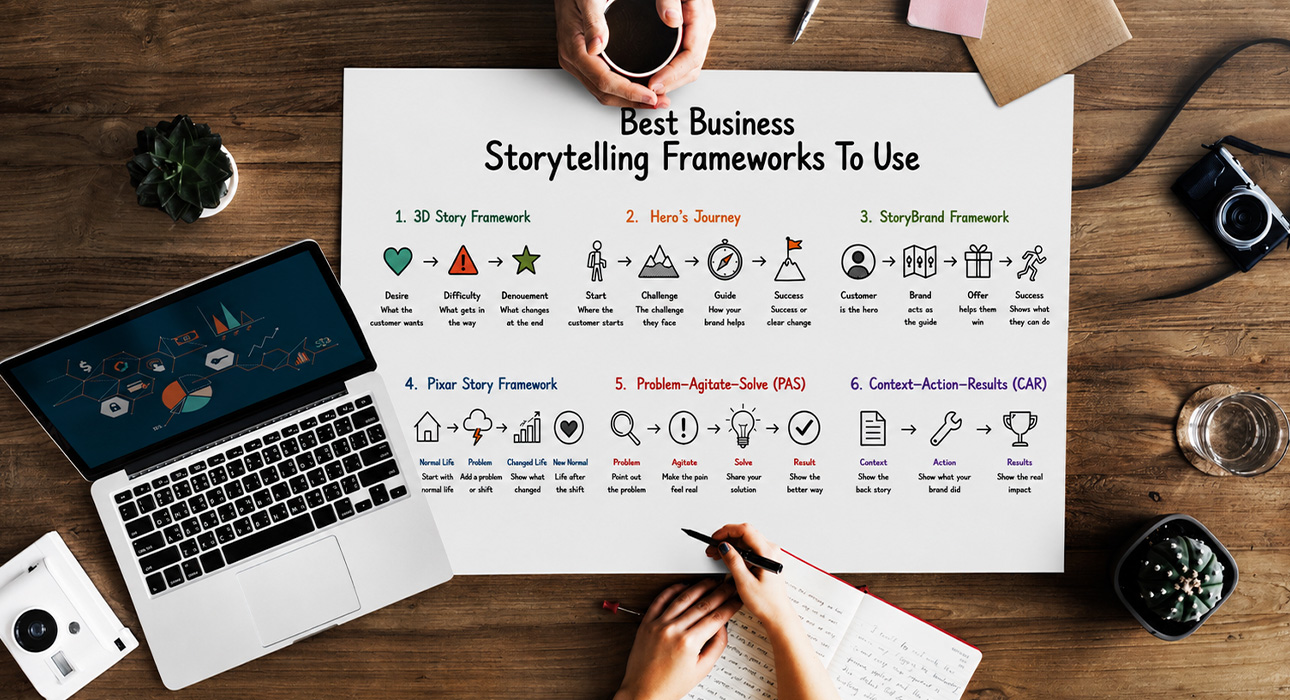 Best Business Storytelling Frameworks To Use
The right business storytelling framework helps you shape your message with more clarity, emotion, and purpose.
Use The 3D Story Framework
The 3D Story Framework keeps your story clear.
It focuses on three parts. What your customer wants. What gets in the way. What changes at the end.
Apple uses this idea well.
The customer wants ease and creativity. The hard part is tech that feels complex. Apple shows life after the product feels simple.
• Desire shows the customer’s goal
• Difficulty shows the roadblock
• Denouement shows the final change
• Before: The customer feels unsure
• After: The customer feels clear and ready
Use The Hero’s Journey
The Hero’s Journey works well when you want to show growth, struggle, and success.
In a business story, your customer is the hero.
Your brand acts as the guide. You help them move past a problem and reach a better result.
Airbnb does the same.
The traveler wants a real travel feel. Airbnb helps them move from visitor to local guest.
• Show where the customer starts
• Share the challenge they face
• Show how your brand helps
• End with success or a clear change
• Before: The customer feels stuck
• After: The customer feels proud and sure
Use The StoryBrand Framework
The StoryBrand Framework keeps the customer at the center.
This works because people care most about their own problem. Your brand should not act like the hero here.
You act as the guide.
Think of Nike.
Nike does not make the shoe the hero. The athlete gets that role. Nike helps them feel bold, ready, and in control.
• Customer is the hero
• Brand acts as the guide
• Your offer helps them win
• Nike shows what the athlete can do
• Before: The customer feels stuck
• After: The customer feels ready
Use The Pixar Story Framework
The Pixar Story Framework works well for simple stories that feel real.
You start with normal life. Then a problem shows up. After that, you show what life looks like after the shift.
Spotify Wrapped does this well.
You use Spotify all year. Then Spotify turns your music data into a fun personal story. At the end, you see your taste, your mood, and your year in one place.
• Start with normal life
• Add a problem or shift
• Show what changed after that
• Spotify Wrapped turns data into a personal story
• Before: The user just hears music
• After: The user sees their year as a story
Use The Problem-Agitate-Solve Framework
PAS works well for sales pages, ads, emails, and web pages.
You start with the problem your reader already feels. Then you make the pain clear. After that, you show your solution.
Slack fits this well.
A team has chats all over the place. Emails pile up. Work feels hard to track. Slack gives the team one clear space to talk and act.
• Point out the problem
• Make the pain feel real
• Share your solution
• Slack shows how messy work can feel
• Before: The team feels lost in chats
• After: The team has one clear place
Use The Context-Action-Results Framework
CAR works best for case studies, reviews, and success stories.
You show the situation first. Then you show what your brand did. After that, you show the result.
Canva is a good example here.
A small team needs a clean design fast. They use Canva to make it with ease. The final result looks sharp and saves time.
• Context shows the back story
• Action shows what your brand did
• Results show the real impact
• Canva shows the value in a clear way
• Before: The team has no design help
• After: The team has a sharp design fast
 How To Apply A Business Storytelling Framework In Marketing
A business story framework helps you turn your message into a simple path your audience can follow.
AI can generate content.
But it can’t replace a strategic narrative structure.
That part still needs your clear thought. You need to know what your audience wants, what blocks them, and what result they care about.
That’s how your message starts to feel less random and more real.
Map Your Audience’s Desire
Start with what your audience wants.
-
Define goals or pain points
-
Make it specific and relatable
Identify The Main Challenge
Show what is holding them back.
-
Highlight frustrations
-
Build urgency
Show The Action That Creates Change
Introduce your solution naturally.
-
Explain how it helps
-
Keep it simple
Prove The Result With Specific Outcomes
End with clear results.
-
Share real outcomes
-
Show transformation clearly
 How To Choose The Right Story Framework
By choosing the right business storytelling framework starts with knowing what you want your content to achieve. Not every framework fits every message, so the best choice depends on your audience, format, and goal.
Match The Framework To The Content Type
Different content types need different storytelling styles. For example, Problem-Agitate-Solve works well for sales pages, ads, and landing pages because it builds urgency. Context-Action-Results is better for case studies and testimonials because it shows proof clearly.
-
Use PAS for persuasive sales content
-
Use CAR for case studies and results
-
Use Pixar or Hero’s Journey for transformation stories
Keep The Story Simple And Practical
A good framework should make your message easier, not harder. Avoid adding too many steps or details. Your audience should understand the story without working too hard.
-
Choose a structure you can repeat
-
Keep the flow clear and natural
-
Remove anything that distracts from the main point
Focus On The Audience Outcome
The strongest business stories always end with change. Show what your audience can gain, improve, or overcome.
-
Highlight the transformation
-
Show practical benefits
-
Keep the customer as the hero
Frequently Asked Questions (FAQs):
What Makes A Business Story Different From A Regular Story?
A business story is designed to drive action and outcomes, not just entertain
Which Storytelling Framework Works Best For Marketing?
The best business storytelling framework depends on the goal, but PAS and StoryBrand are highly effective for marketing.
How Do You Use Storytelling In B2B Marketing?
Use storytelling in B2B by focusing on real customer challenges, decisions, and measurable results.
Can Any Business Use Storytelling Frameworks?
Yes, any business can use storytelling frameworks to communicate clearly, connect emotionally, and drive engagement.
Conclusion
A business story framework helps you turn scattered ideas into a clear story. One that people can understand, remember, and act on.
When your story has the right flow, it does more than share facts.
-It builds trust.
-It creates a real link.
-It helps your audience care.
But your story should grow as your business grows.
So keep your message fresh. Test what works. Sharpen how you say it. Make sure your audience still feels the point.
Next time you create content or share an idea, ask yourself this:
Are you just share facts?
Or are you lead your audience through a story they can feel?
The brands that win attention today do not say more.
They say it with more clarity.
And that is where Brief Cab helps.
Brief Cab helps you turn your ideas into clear visual stories that look sharp, feel strong, and speak to the right people.
Explore more tips, or connect with Brief Cab to turn your ideas into stories that truly work.